How an Automobile Branding Agency Uses Meta Ads for Vehicle Sales
A practical guide to automotive audience targeting, creative strategy, lead generation, retargeting, local campaigns, CRM follow-up and performance optimization.
How can automobile businesses use Meta Ads effectively?
Automobile businesses can use Meta Ads to reach relevant audiences, promote vehicle-specific content, generate enquiries, support test-drive campaigns and reconnect with people who previously interacted with their marketing.
The strongest approach connects paid advertising with landing pages, lead qualification, CRM workflows and sales-team follow-up instead of treating ad campaigns as an isolated activity.
In the competitive automobile market, customers can search, compare and evaluate vehicles online before visiting a dealership. Meta Ads can therefore become one part of a larger digital journey that moves customers from awareness to enquiry and showroom interaction.
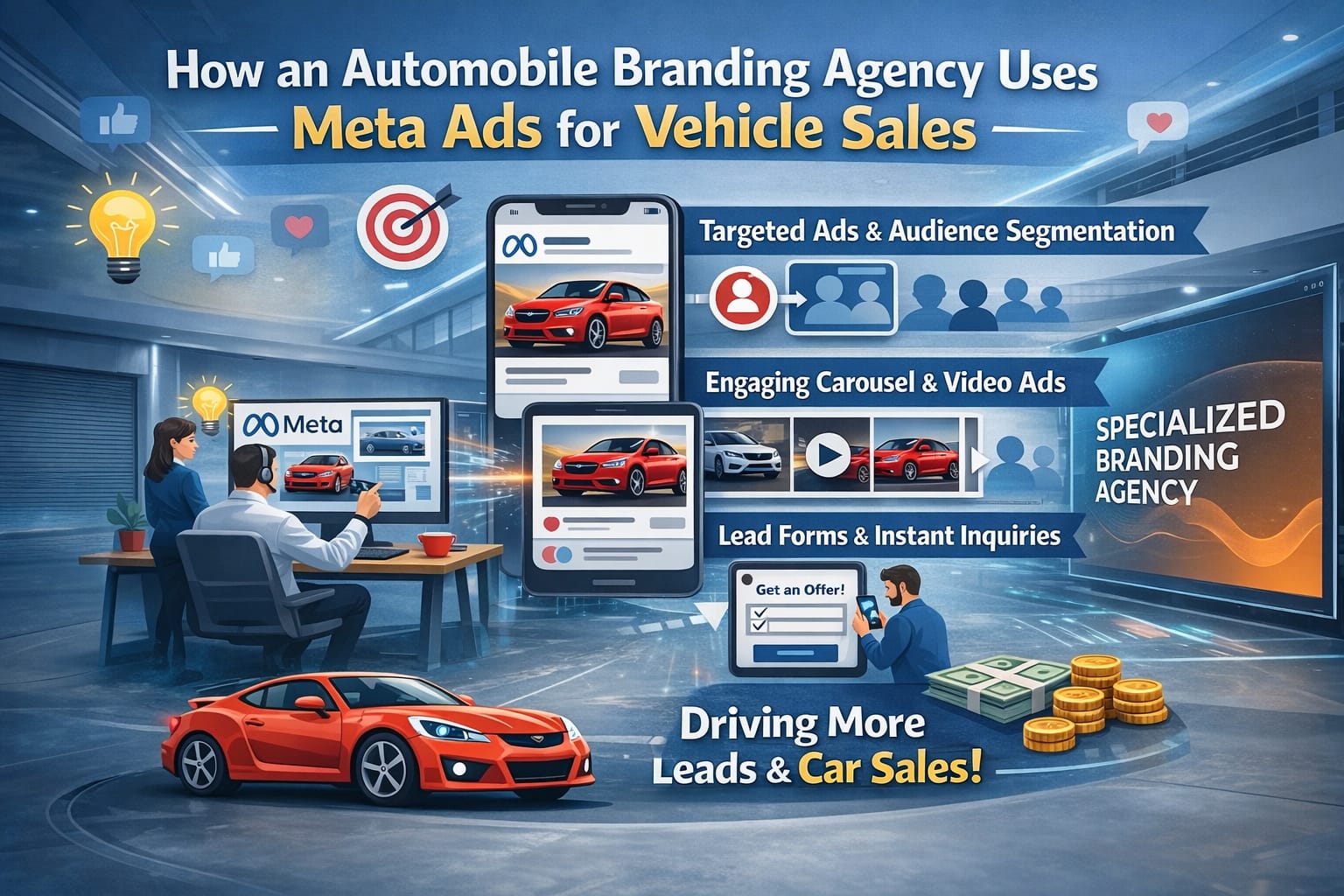
An automobile branding agency can combine audience research, creative strategy, campaign structure, local relevance, lead qualification, retargeting and sales follow-up into a single marketing system.
Effective campaigns begin with understanding the people the dealership wants to reach rather than showing the same message to everyone.
Audience Profile
Consider relevant customer characteristics, interests and buying context.
Location
Identify the geographic areas realistically served by the showroom.
Vehicle Preference
Segment campaigns by relevant categories such as bikes, scooters, cars, commercial vehicles or EVs.
Customer Intent
Separate discovery, consideration, enquiry and remarketing audiences where appropriate.
Audience settings should be treated as testable campaign inputs. Performance data should determine which segments deserve more or less budget.
Automotive advertising is highly visual. Creative should communicate useful information quickly while fitting the campaign objective.
Vehicle Reels
Showcase vehicle features, walk-throughs and use cases in short-form content.
Delivery Content
Use authentic customer-delivery moments where appropriate to communicate experience.
Offer Creatives
Communicate relevant promotions, finance information or seasonal campaigns clearly.
EV Education
Explain electric-vehicle ownership topics that commonly matter to potential buyers.
Instead of showing only a vehicle photograph, combine product information, customer benefits, context and a clear next action.
Different campaign stages can serve different business objectives. A dealership should map its campaigns to the customer's journey.
Awareness
Introduce the dealership, vehicle category or new offering.
Engagement
Build familiarity using informative or entertaining content.
Lead Generation
Encourage relevant prospects to submit enquiries or take another desired action.
Retargeting
Reconnect with audiences that previously interacted with the campaign.
Physical dealerships generally serve geographic markets. Local campaign planning can therefore be important for reducing irrelevant reach and connecting advertising with realistic showroom access.
Showroom Area
Build campaigns around the areas that realistically contribute to showroom visits.
Nearby Towns
Include relevant nearby communities when they fall within the dealership's service market.
Local Intent
Connect messaging with local dealership, service and vehicle-search intent.
A dealership may test a close geographic radius around its showroom, nearby towns or other relevant local segments. The exact geographic settings should be based on the dealership's actual service area and campaign performance rather than a fixed rule.
Lead forms should balance ease of submission with the information required by the sales team.
Simple Forms
Useful when reducing friction and maximizing the number of enquiries is the priority.
Qualification Questions
Add relevant questions when the sales team needs more information to prioritize follow-up.
Clear Thank-You Action
Give users a clear next step after submitting the form.
CRM Integration
Send leads into a structured workflow so sales teams can track and manage them.
Lead generation becomes more valuable when marketing and sales share the same definition of a qualified opportunity.
Not every customer acts after seeing one advertisement. Retargeting can be used to continue communication with eligible audiences who previously interacted with the business.
Video Viewers
Build follow-up campaigns around audiences who engaged with video content.
Engaged Users
Continue communication with users who interacted with campaign content.
Website Visitors
Re-engage eligible visitors with relevant next-step content.
Lead Prospects
Coordinate follow-up communication with suitable prospects through the sales process.
Paid campaigns require measurement and iteration. Performance should be evaluated against both advertising metrics and downstream sales outcomes.
Cost per Lead
Monitor how efficiently campaigns generate enquiries.
Lead Quality
Review which leads become meaningful sales opportunities.
Creative Performance
Compare creatives and identify which messages attract useful attention.
Audience Performance
Identify audience groups that contribute stronger outcomes.
Budget Allocation
Shift investment according to campaign objectives and observed performance.
Business Outcomes
Connect advertising activity to enquiries, test drives and sales where tracking permits.
Advertising performance cannot be evaluated properly when marketing stops at the form submission. The sales process must continue from there.
Lead Assignment
Send enquiries into a clear ownership and follow-up workflow.
Lead Qualification
Record relevant information and identify buying intent.
CRM Tracking
Track contact attempts, stages, notes and outcomes.
Feedback Loop
Use sales feedback to improve audiences, creatives and offers.
Marketing and sales should function as one connected funnel: Ad → Lead → Follow-up → Test Drive → Opportunity → Sale .
New vehicle categories can create additional customer questions. EV campaigns can therefore combine product promotion with education.
EV Education
Explain charging, ownership and technology topics in clear language.
Ownership Questions
Address common questions around range, charging and day-to-day use.
Finance Content
Present applicable finance information and comparisons clearly.
Launch Campaigns
Build awareness and consideration around new models or product categories.
The advertising platform is only one part of the system. Industry understanding helps determine what to promote, who to reach, how to communicate value and how to connect marketing with dealership operations.
Buyer Psychology
Understand the concerns and motivations behind vehicle purchases.
Seasonal Campaigns
Plan relevant campaigns around local and business-specific buying cycles.
Vehicle Positioning
Adapt messaging to vehicle category, customer segment and business objective.
Local Competition
Build campaigns around the dealership's real geographic market.
Paid campaigns work best as part of a wider digital ecosystem. SEO can support long-term discovery of the same products, services, locations and customer questions promoted through advertisements.
Vehicle Pages
Create detailed, useful pages around relevant vehicle categories and customer intent.
Dealership Pages
Make location, service information, contact paths and customer information easy to find.
Content Marketing
Publish comparison guides, ownership content, FAQs and educational articles.
Technical SEO
Maintain crawlable pages, logical URLs, internal links, canonicalization and mobile usability.
Create direct answers to questions customers may search before or after seeing a paid advertisement.
Vehicle Questions
Answer questions about features, variants, comparisons and ownership.
Finance Questions
Explain relevant finance, EMI and exchange processes clearly.
Test Drive Questions
Explain how customers can enquire and what the test-drive process involves.
Service Questions
Cover service, maintenance and dealership support information.
Generative search visibility depends on having clear, trustworthy and well-structured business information available across your digital presence.
Vehicle Entity
Clearly describe relevant vehicle categories, models and relationships.
Dealership Entity
Make business identity, ownership, location and services understandable.
Local Context
Clearly communicate cities, service areas and local customer relevance.
Trust Signals
Keep important information accurate and consistent across relevant sources.
Helpful Content
Answer real customer questions with useful and original information.
Technical SEO
Keep important pages discoverable, crawlable and logically structured.
Topical Authority
Build connected content around vehicles, dealership services and ownership.
Local Relevance
Make dealership location and service-area information explicit.
Entity Clarity
Clearly identify the business, vehicles, services and people involved.
Question Coverage
Answer questions around vehicles, finance, service and test drives.
Internal Linking
Connect related vehicle, service, location and educational pages.
Brand Consistency
Keep important business information accurate across relevant channels.
Qualified Leads
Measure the relevance of the enquiries rather than only total volume.
Test Drive Enquiries
Track customer actions that indicate stronger purchase consideration.
Conversion Rate
Connect campaign enquiries with downstream business outcomes where possible.
Campaign Efficiency
Compare spend against the objective and quality of the campaign.
Sales Follow-Up
Track response, contact attempts and lead-stage progression.
Organic Discovery
Monitor whether supporting SEO and content assets continue generating discovery.
How do automobile branding agencies use Meta Ads?
They can use Meta Ads as part of a structured funnel involving audience research, creative development, campaign planning, lead generation, retargeting, performance monitoring and sales-team follow-up.
What types of Meta Ads are useful for automobile dealerships?
Depending on the business objective, dealerships can use campaigns focused on awareness, engagement, lead generation, remarketing, vehicle education, offers, test drives and new model launches.
How should an automobile business target customers on Meta?
Targeting should be based on the dealership location, relevant audience characteristics, vehicle category, campaign objective and customer intent. Exact audience settings should be tested and adjusted using campaign performance data.
Why are creative ads important for automobile marketing?
Automobile purchases are highly visual and information-heavy. Strong creative content can communicate vehicle features, use cases, offers, ownership value and customer experiences in a format that is easy to understand.
Can Meta Ads generate vehicle sales directly?
Meta Ads can generate awareness, enquiries and other customer actions, but final vehicle sales depend on many factors including product fit, pricing, dealership experience, lead quality, availability and sales follow-up.
What is retargeting in automobile advertising?
Retargeting involves reaching people who previously interacted with relevant content or marketing assets, where the platform and campaign configuration support that activity. The goal is to continue the customer journey with more relevant messaging.
Why is local targeting important for car and bike dealerships?
Physical dealerships serve defined markets. Local campaign strategies can reduce irrelevant reach and focus marketing on people within the areas that the dealership realistically serves.
Should automobile Meta Ads connect to a CRM?
Connecting advertising leads with a CRM can help sales teams organize enquiries, assign follow-ups, track lead stages and measure what happens after the initial form submission or enquiry.
How quickly should automobile leads be followed up?
Fast and organized follow-up is generally important because a lead can lose interest or engage with competing dealerships. The appropriate response workflow depends on the dealership team, operating hours and lead-management process.
What should automobile businesses measure in Meta Ads?
Useful metrics can include spend, impressions, reach, click or engagement metrics, cost per lead, lead quality, conversion rates, test-drive enquiries, sales outcomes and the relationship between advertising spend and business results.
How can Meta Ads support EV marketing?
EV campaigns can use educational content to explain topics such as charging, ownership, range, technology, finance and other customer questions. This can help move audiences from awareness toward consideration.
How do SEO, AEO and GEO complement Meta Ads?
Paid campaigns create immediate audience and traffic opportunities, while SEO, AEO and GEO help build a discoverable information ecosystem around the dealership, vehicle categories, customer questions, locations and brand identity.
Meta Ads can be an important part of an automobile dealership's digital marketing system, but effective results depend on more than simply launching advertisements.
Audience research, creative quality, campaign structure, local relevance, lead qualification, retargeting, performance measurement and sales follow-up all contribute to the customer journey.
When paid campaigns are supported by strong landing pages, SEO, AEO, GEO, local search and CRM workflows, the dealership can build a more connected digital acquisition system.
At Alfa Tech Industries, our automobile-focused approach combines branding, Meta Ads, digital marketing and lead-management strategies to support dealership growth.
Ready to Drive Your Automotive Marketing Forward?
Build an automotive advertising strategy combining Meta Ads, branding, local marketing, SEO, AEO, GEO and lead-management workflows.
Talk to Our Automobile Branding ExpertsTurn advertising attention into a structured customer journey.