The opportunity
Why food manufacturers are moving online
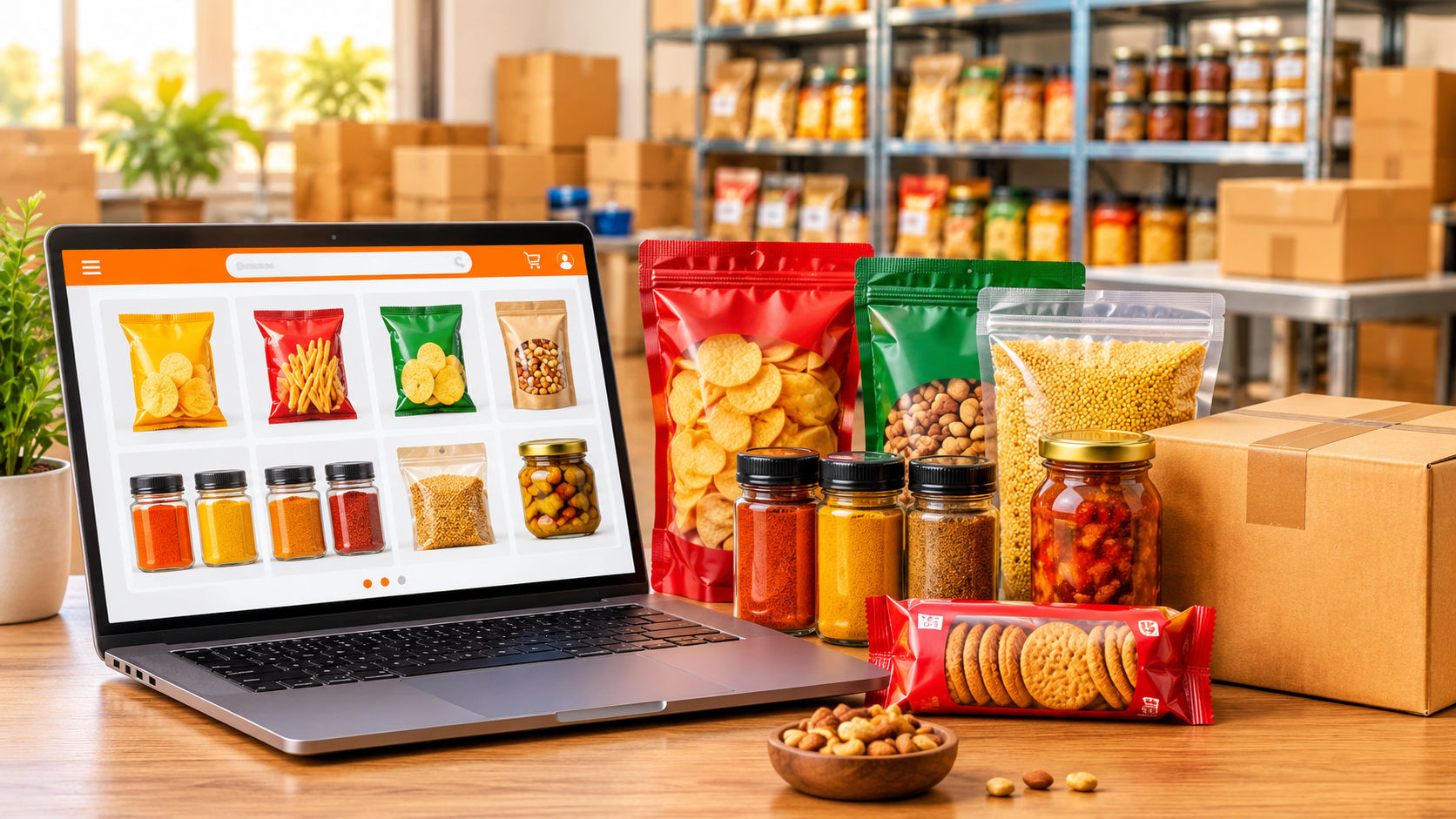
More consumers and business buyers now discover, compare and purchase food products online. From packaged snacks and spices to beverages, organic products and ready-to-cook foods, online shopping is opening new opportunities for food manufacturers in India.
Traditionally, manufacturers have relied on distributors, wholesalers, supermarkets and retail shops. Those channels remain important, but an e-commerce website for food manufacturers adds an independent sales channel that the business owns and controls. Instead of depending entirely on third-party marketplaces, you can showcase products, accept orders, collect payments and build direct customer relationships under your own brand.
This guide explains how to build a professional food product catalogue, accept wholesale and retail orders, manage delivery and inventory, and encourage repeat purchases. If you are exploring dark-store and platform selling instead, read our guide on Quick Commerce Onboarding for Manufacturers. If you are ready to build, see our e-commerce website development services.
01 / The basics
What is an e-commerce website for food manufacturers?
It is an online shopping and business-ordering platform that allows manufacturers to display, promote and sell food products through the internet. It supports two primary models:
Key benefits
- Direct customer access: build relationships without depending only on distributors.
- Brand control: present products and brand identity professionally.
- Wholesale opportunities: let retailers and distributors order in bulk online.
- Centralized order management: handle all orders in one administrative system.
- Inventory visibility: reduce errors caused by outdated stock information.
- Business expansion: reach customers beyond your local distribution network, subject to delivery capabilities.
- Customer retention: encourage repeat purchases through accounts, saved orders and reminders.
A website does not automatically generate sales. Results depend on product demand, pricing, marketing, fulfilment, customer experience and operational consistency.
02 / Choose your model
Can one website handle wholesale and retail orders?
Yes. Manufacturers that sell to both consumers and distributors can use a hybrid model with separate purchasing experiences on one platform. A shopper buying one packet of snacks does not follow the same process as a distributor ordering several cartons, so decide which customers you serve before development begins.
| Requirement | B2C store | B2B portal |
|---|---|---|
| Customers | Individual consumers | Retailers and distributors |
| Pricing | Retail price | Wholesale or account-specific price |
| Order quantity | Individual packs | Bulk quantities and cartons |
| Login | Optional or customer account | Registered business account |
| Payment | UPI, cards and other supported methods | UPI, bank transfer and configured payment terms |
| Minimum order | Usually low or none | Configurable MOQ |
| Reordering | Customer order history | Saved bulk orders and repeat purchase |
Can food manufacturers sell directly to consumers?
Yes. A B2C food store suits categories such as packaged snacks and namkeen, biscuits and bakery, spices and masala powders, pickles and condiments, ready-to-cook foods, millet and organic products, beverages and sweets. Core features include product browsing, shopping carts, customer accounts, secure payments, delivery options, order tracking and reviews. This direct-to-consumer channel complements your distributor network, subject to business, food safety, tax and fulfilment requirements.
What does a B2B food ordering website need?
A wholesale food ordering website typically includes wholesale catalogues, minimum order quantities, carton-based ordering, customer-specific pricing, distributor and retailer accounts, quotation forms, purchase order management, GST invoice generation where applicable and repeat ordering.
03 / Product catalogue
Build a food product catalogue customers can trust
The product catalogue is one of the most important parts of a food manufacturer e-commerce website. Customers need to understand what a product contains, how it is packaged, which quantity is available and how to buy it. A disorganized online product catalogue for manufacturers creates confusion and reduces confidence.
Basic information
Product name, brand, category, SKU or product code, description, variant, net quantity, pack size and unit of measurement.
Food-related information
Ingredients, nutritional and allergen information where applicable, veg or non-veg declaration, storage instructions, shelf life, FSSAI licence details and required label information.
Commercial information
MRP where applicable, selling and wholesale price, MOQ, carton quantity, tax details, bulk discount structure and availability.
Product images
Front pack, back pack and label images, product photographs, multiple pack sizes and serving images where relevant.
Suggested category structure
| Main category | Example subcategories |
|---|---|
| Snacks | Chips, mixture, namkeen, traditional snacks |
| Spices | Turmeric, chilli powder, masala mixes |
| Bakery | Biscuits, cookies, cakes |
| Beverages | Juices, packaged drinks, beverage mixes |
| Pickles | Mango, lemon, mixed vegetables |
| Ready-to-Cook | Instant mixes, cooking products |
| Health-focused foods | Millet products, eligible organic products |
Reflect your actual products in the structure. Each product should have its own page with a descriptive title, images, accurate specifications, pricing, quantity options and availability. For packaged food, show clear, readable images of the packaging and provide the mandatory food information that applies.
04 / Wholesale
How can food manufacturers manage bulk orders?
Use a centralized B2B ordering system. Wholesale ordering often still happens through phone calls, WhatsApp messages and spreadsheets; a bulk food ordering platform brings it into one place with these features:
Minimum order quantity (MOQ)
Set the minimum quantity per product, for example 5 cartons for a retailer and 20 for a distributor. These are illustrative; configure them to your commercial policy.
Wholesale price slabs
Illustrative example: 1–10 cartons at ₹1,000, 11–50 cartons at ₹950 and 51–100 cartons at ₹900. Actual prices depend on costs, margins and agreements.
Customer-specific pricing
Registered distributors can see negotiated pricing that differs from the general price list.
Quotations and purchase orders
Let buyers request quotes for freight estimates or custom specifications, then submit and track purchase orders.
Quick bulk and repeat ordering
Enter quantities directly from listings and reorder previous product combinations without retyping every item.
05 / Payments
What payment options should an online food store support?
A smooth payment process converts shoppers into paying customers. Choose methods that suit your target buyers:
- UPI, debit and credit cards, net banking and wallets through a compatible payment gateway.
- Cash on delivery where commercially appropriate, considering extra costs, failed deliveries and return risk.
- Bank transfers for wholesale orders, subject to your invoicing and confirmation process.
- Business credit terms for established distributors, controlled through customer accounts and internal approval.
For online payment integration for a food business, compare supported methods, transaction charges, settlement timelines, refund capabilities, payment status notifications, security requirements and reconciliation reports. The site should update payment and order status accurately and handle failed or pending transactions clearly. Good wholesale payment management also links approved credit limits to each business account.
06 / Delivery
How can manufacturers manage online food delivery?
Selling food online means products must reach customers in suitable condition and on time. Requirements differ for shelf-stable, fragile, chilled, frozen and perishable items. Effective food delivery integration usually covers:
- Delivery location checks: customers enter a PIN code to confirm serviceability.
- Shipping rate calculation: based on zones, weight, volume, destination and provider pricing.
- Courier integration: connect providers such as Shiprocket, Delhivery or India Post, depending on availability and suitability.
- Order tracking and dispatch management: packing, labels and delivery status for administrators and customers.
- Bulk shipment handling: larger wholesale consignments and commercial dispatch needs.
Plan packaging by product type: protective packing for snacks, leak-resistant packing for bottled products, temperature-aware shipping for chocolate and proper cold-chain handling for frozen or perishable foods. Food product shipping management should also check remaining shelf life before allocating stock to an order.
07 / Inventory
How can food manufacturers manage expiry dates and stock?
Without accurate stock data, businesses accept orders for unavailable products, oversell inventory or miss items approaching expiry. A food inventory management system should include:
For example, if 1,000 packets are produced in two batches and the first expires earlier, batch-level expiry data helps warehouse staff identify which stock to consider for dispatch first. This food stock management system approach is especially valuable for manufacturers with several production dates and sales channels.
FSSAI has emphasized minimum remaining shelf-life practices for food delivered through e-commerce, so build stock allocation and dispatch checks into your workflow.
08 / Retention
How can manufacturers encourage repeat purchases?
Winning the first order is only part of growth. Repeat customers are an ongoing source of revenue, especially for products bought regularly. Make returning easy with:
- Customer accounts showing past orders and saved addresses.
- One-click reordering and saved shopping lists.
- Subscriptions or scheduled orders where suitable, such as monthly breakfast product deliveries.
- Loyalty programs with clearly defined rules.
- Personalized offers based on preferences and history, with appropriate consent.
- Email and WhatsApp notifications for order confirmations and delivery updates, following consent, privacy and messaging requirements.
Integrating the store with CRM software also helps record enquiries, purchase history and sales interactions, which is particularly useful when managing distributors and retailers who order regularly.
09 / Compliance
Is FSSAI licensing required to sell food products online?
Food Business Operators must hold the appropriate FSSAI registration or licence. The correct category depends on business activity, turnover and the role the business plays in an online sales arrangement. As of November 2026, FSSAI's 2026 licensing amendments introduced revised turnover thresholds effective 1 April 2026 and perpetual validity provisions, and the authority has issued e-commerce-specific clarifications.
| General category | Annual turnover |
|---|---|
| Registration | Up to ₹1.5 crore |
| State licence | Above ₹1.5 crore up to ₹50 crore |
| Central licence | Above ₹50 crore |
Turnover alone does not decide your licence. A manufacturer selling through its own platform should verify its Kind of Business, including any e-commerce licensing requirement, through the current FoSCoS portal instead of assuming a manufacturing licence covers every online-selling activity.
Product information and claims
Product pages should carry accurate information for the category, which may include ingredients, allergen declarations, nutritional information, net quantity, veg or non-veg mark, manufacturer details, FSSAI licence number, storage instructions and date or batch details. Avoid claims such as organic, sugar-free, high-protein or immunity-boosting unless they are legally supportable. See FSSAI's labelling and display regulations.
Shelf life and GST
Manage shelf life from warehouse allocation through to delivery, and check the latest FSSAI remaining-shelf-life criteria for your product and selling model. Configure GST classification, invoices and tax calculations carefully: CBIC's GST sectoral FAQs distinguish a business selling its own goods through its own website from a marketplace collecting payment for third-party suppliers, which can affect TCS treatment.
This section is a practical overview, not a substitute for advice from an FSSAI compliance professional or GST practitioner. Verify current rules before publishing product claims or configuring billing.
10 / Discoverability
E-commerce SEO for food manufacturers
A website only helps if customers can find it. E-commerce SEO helps search engines understand your categories, products and brand. Our SEO services for businesses cover this in more depth; the essentials are:
- SEO-friendly URLs, such as /products/traditional-millet-snacks/.
- Category pages targeting searches like packaged snacks online or traditional Indian spices.
- Unique product titles and descriptions for every product.
- Image SEO: descriptive filenames (traditional-millet-snacks-200g.webp) and meaningful alt text.
- Product and Offer structured data on individual, purchasable product pages with accurate name, image, brand, SKU, price, currency and availability. Do not apply merchant markup indiscriminately to category pages.
- Google Merchant Center: evaluate product feeds and free listings for your market.
- Mobile optimization, internal linking and technical SEO: clean URLs, canonical tags, XML sitemaps, indexable pages and fast loading.
Google's e-commerce SEO documentation explains how product data can support eligible listings.
11 / Measurement
Measure what your online store actually achieves
Traffic alone does not show whether customers buy or whether wholesale enquiries are valuable. Track these metrics with Google Analytics 4 or a suitable platform, and connect order data to your backend or CRM:
| Metric | What it tells you |
|---|---|
| Product page views | Which products customers explore |
| Add-to-cart rate | How often customers add products |
| Checkout completion and cart abandonment | How well checkout converts |
| Conversion rate | Percentage of visitors who purchase |
| Average order value | Average value of completed orders |
| Repeat purchase rate | Customers returning to buy again |
| Stock turnover | How quickly products move through inventory |
| Wholesale enquiries | Business buyers requesting bulk prices or quotes |
| Customer acquisition cost | Marketing cost to win a customer |
12 / Illustration
Example: a Tamil Nadu snack manufacturer goes online
Consider a fictional company, ABC Foods, based in Tamil Nadu. It makes packaged snacks, millet products and traditional foods, and has depended mainly on local distributors and retail shops. It builds its own e-commerce website:
- It creates categories, product pages, images, descriptions, pack sizes and food information.
- Consumers browse, add to cart, pay online and choose available delivery options.
- Distributors and retailers register business accounts, view wholesale prices and order according to MOQs.
- The company tracks stock, batches, expiry dates and warehouse availability.
- Orders are packed and dispatched through suitable logistics partners, and customers reorder from their order history.
The manufacturer now has a digital sales channel alongside its traditional distribution network.
This is an illustrative scenario, not a real client case study or a claim of guaranteed sales growth.
13 / Avoid these issues
Common mistakes food manufacturers should avoid
Marketplaces add reach, but depending on one limits control over customer experience and sales.
Use accurate, professional images of the actual products and packaging.
Missing ingredients, pack sizes, storage or label details reduce buyer confidence.
Account for distributors and commercial buyers, not just small retail orders.
Accepting orders for unavailable products leads to cancellations and complaints.
Plan packaging, shelf life, delivery areas and temperature needs for each product.
Unclear shipping charges and limited payment options cause abandoned orders.
Use order history, saved products, accounts and appropriate communication.
14 / Choosing a partner
How to choose an e-commerce development partner
Your platform should support how you manufacture, sell, store and distribute products. Before choosing a provider, evaluate:
- Industry understanding: the difference between retail sales, wholesale distribution and manufacturer-to-distributor ordering.
- Custom catalogue: support for categories, sizes, flavours, packaging options and product information.
- B2B and B2C support: separate pricing and ordering experiences.
- Inventory integration: SKU management, stock updates, batch records and expiry tracking.
- Payment and shipping integration: the gateways, couriers, calculations and tracking you need.
- SEO and performance: clean URLs, optimized product pages, structured data and mobile speed.
- Admin dashboard: routine management of products, orders, customers, pricing, promotions and reports without developer help.
- Scalability and support: room for more products, customers, warehouses and order volume.
How much does a food manufacturing e-commerce website cost?
The cost depends on product count, B2B and B2C functionality, custom design, payment integration, inventory management, shipping integrations and CRM or ERP requirements. A custom quotation should follow an understanding of your workflow.
15 / Alfa Tech Industries
Custom e-commerce website development for food manufacturers
Food manufacturers need more than a simple website. They need an organized platform that connects catalogues, customer accounts, bulk ordering, payments, delivery, inventory and customer management. Alfa Tech Industries, based in Madurai, Tamil Nadu, provides custom e-commerce website development for businesses across Tamil Nadu and India that want to establish or expand online sales.
Whether you make snacks, spices, beverages, bakery products, packaged foods or organic products, we plan the platform around your actual business requirements.
Alfa Tech Industries · Madurai, Tamil Nadu
Building custom B2B and B2C e-commerce platforms for businesses in Tamil Nadu and across India.
The next step
Give your products a digital storefront you own
The way food products are discovered and purchased is changing. An e-commerce website for food manufacturers gives you an independent sales channel alongside your distributor, retailer and supermarket network, with product catalogues, wholesale ordering, retail sales, payments, inventory, delivery and customer relationships in one platform.
Start with a clear product catalogue, choose the right B2B or B2C model, organize inventory and delivery workflows, and build a purchasing experience that customers and business buyers can trust.
Quick answers
Frequently asked questions about e-commerce for food manufacturers
What is an e-commerce website for food manufacturers?
It is an online shopping and business-ordering platform where a food manufacturer displays, promotes and sells its own products. It can serve individual customers (B2C) and distributors, wholesalers, retailers and other commercial buyers (B2B) from one system.
How can food manufacturers sell products online?
Food manufacturers can sell online by creating their own e-commerce website, listing products with accurate food information, configuring online payments, managing inventory and arranging delivery. The best setup depends on product type, order volume, wholesale requirements and budget.
Can food manufacturers sell directly to consumers?
Yes. Manufacturers can build a direct-to-consumer channel through their own website, subject to applicable business, food safety, tax and fulfilment requirements. It can complement the existing distributor and retailer network.
Can one website handle wholesale and retail orders?
Yes. A custom platform can offer separate B2B and B2C experiences, including retail pricing, wholesale pricing, minimum order quantities, customer-specific rates and bulk ordering.
How can food manufacturers manage bulk orders?
Use B2B features such as minimum order quantities, carton-based products, bulk price slabs, distributor accounts, quotation requests, purchase order management and repeat bulk orders.
How can food manufacturers manage expiry dates?
An inventory system can record batch numbers, manufacturing dates, best-before or expiry dates, stock quantities and warehouse locations. A FEFO (First Expired, First Out) workflow can prioritize stock with the earliest expiry where appropriate.
What payment options should an online food store support?
Depending on your customers, offer UPI, debit and credit cards, net banking, supported wallets, suitable cash on delivery arrangements and bank transfers for wholesale orders. Approved credit terms can be controlled through business accounts.
How can manufacturers manage online food delivery?
Use suitable courier and logistics providers with PIN code checks, shipping rate calculation, dispatch processing and tracking. Perishable or temperature-sensitive foods may need specialized packaging and cold-chain logistics.
Is FSSAI licensing required to sell food products online?
Food businesses must hold the applicable FSSAI registration or licence. E-commerce activity can carry specific Kind of Business or licensing requirements, so verify your exact activity and selling model through FoSCoS rather than relying on turnover alone.
How much does a food manufacturing e-commerce website cost?
Cost depends on the number of products, B2B and B2C functionality, custom design, payment integration, inventory management, shipping integrations and CRM or ERP requirements. A custom quotation should be prepared after understanding your workflow.
Can the website integrate with inventory, billing and CRM systems?
Yes. A properly planned website can integrate with compatible inventory, billing, accounting, CRM and ERP systems through available APIs or custom integrations.
Can food manufacturers deliver across India?
Yes, to supported locations, provided you have suitable logistics, packaging, pricing, tax and fulfilment arrangements in place.