Learn how to structure useful content for answer-oriented and generative search experiences while maintaining strong technical SEO foundations.
What is Answer Engine Optimization?
Answer Engine Optimization (AEO) is commonly used to describe the practice of structuring useful information so questions can be answered clearly in search and answer-oriented experiences. Effective AEO starts with strong SEO foundations: crawlable content, clear structure, useful information, relevant internal links and accurate context.
Why AEO Matters for Modern Search Visibility
In 2025, ranking #1 on Google is no longer enough. The real challenge is creating useful information that can satisfy users across traditional search and newer answer-oriented experiences.

Welcome to Answer Engine Optimization (AEO) — a content strategy focused on answering questions clearly while maintaining the technical and content foundations required for search visibility.
This guide explains how AEO, SEO and GEO can work together through useful content, structured information, entity context, search intent and continuous measurement.
What Is Answer Engine Optimization (AEO)?
Answer Engine Optimization is commonly described as the practice of creating and structuring content so that important questions can be answered directly and clearly.
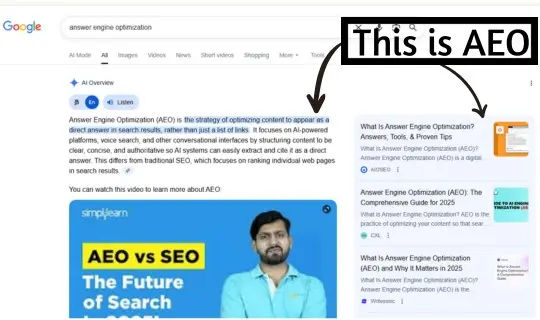
Unlike a keyword-only approach, an answer-focused strategy considers the question behind the search, the information needed to satisfy it, and the clearest way to present that information.
AEO and GEO should not be treated as replacements for SEO. Technical SEO, useful content, clear organisation and accessible web pages remain important foundations.
Statistics Cited in the Original Article
The figures below were present in the supplied article. Verify the underlying sources before using them as authoritative marketing claims.
Zero-Click Searches
The original article attributes this figure to SparkToro, 2025.
AI Overview SERPs
The original article attributes this figure to SEMrush Sensor.
Perplexity Users
User figure stated in the original article.
Web Citations
The original article discusses citation-enabled AI search experiences.
AEO vs SEO vs GEO
These terms describe overlapping optimisation approaches, not three completely independent ranking systems.
| Factor | SEO | GEO | AEO |
|---|---|---|---|
| Primary focus | Search visibility and useful organic discovery | Visibility in generative search experiences | Clear answers to user questions |
| Content structure | Useful, organised and search-intent aligned | Useful, original and context-rich | Direct, scannable and question-focused |
| Important signals | Crawlability, content, links, UX and relevance | Content quality, context and accessibility | Direct answers, headings, lists and explanations |
| Measurement | Impressions, clicks and conversions | Generative visibility and brand representation | Answer visibility and question coverage |
How Answer-Oriented Search Can Understand Your Content
The original article presents a list of supposed AEO ranking factors. Rather than treating those points as guaranteed ranking formulas, use them as practical optimisation areas.
Clear Author & Organisation Identity
Make it easy to understand who created the content and which organisation is responsible for it.
Structured, Scannable Content
Use clear headings, short paragraphs, lists, tables and direct answers where appropriate.
Accurate Structured Data
Use schema that accurately represents visible page information and relevant entities.
Genuine Third-Party Recognition
Relevant mentions and references can strengthen digital context, but there is no guaranteed citation formula.
Meaningful Freshness
Update information when it becomes outdated or inaccurate, rather than changing dates without meaningful improvements.
Useful External References
Cite or reference relevant authoritative information where it genuinely supports the reader.
The Complete 7-Step AEO Framework
Use this framework as a practical content and search- visibility workflow instead of treating it as a guaranteed ranking formula.
Claim and Strengthen Your Entity
The article recommends strengthening your organisation and author identity across relevant digital properties so the business can be understood consistently.
Maintain a clear organisation identity. Use consistent business name, website and contact information. Create strong author information and author pages. Connect important business profiles where appropriate. Build consistent entity references across the web.
Build a Clearly Structured Answer Page
Create pages around real questions and place the direct answer close to the start of the relevant section.
Primary question or topic. Short direct answer. Why the answer is useful or correct. Step-by-step explanation. Comparison table when relevant. Common mistakes or considerations. Tools and resources. Frequently asked questions.
# Primary Question

Short, direct answer.

## Why This Matters

Useful explanation and supporting evidence.

## Step-by-Step Breakdown

1. Action step
2. Action step
3. Action step

## Comparison

| Factor | Option A | Option B |

## Common Mistakes

- Mistake 1
- Mistake 2

## FAQ

### Question 1?

Direct answer.

### Question 2?

Direct answer.Use Accurate Structured Data
Use schema markup where it accurately represents the visible content and helps search engines understand the page.
Article or BlogPosting where appropriate. Organization information. Person information for identifiable authors. BreadcrumbList for article navigation context. FAQPage only when the visible page actually contains the corresponding FAQ content.
<script type="application/ld+json">
{
  "@context": "https://schema.org",
  "@type": "Article",
  "headline": "Your Article Title",
  "author": {
    "@type": "Person",
    "name": "Author Name"
  },
  "publisher": {
    "@type": "Organization",
    "name": "Your Company"
  }
}
</script>Make Important Content Crawlable
The important principle is to make useful website content available to search systems without blocking legitimate crawling.
Keep important public pages accessible. Avoid accidental noindex directives. Do not block important content unnecessarily in robots.txt. Maintain a healthy sitemap. Check indexing with Google Search Console. Review server and rendering problems that may prevent content discovery.
User-agent: *
Allow: /

Sitemap: https://alfatechindustries.com/sitemap.xmlRun Regular AI Visibility Audits
Test how your content is represented across relevant search experiences and record which questions lead users to your topic.
Test important customer questions. Compare results across different search experiences. Review whether your organisation is accurately represented. Identify missing questions. Find pages that deserve stronger internal links. Update content when information becomes outdated.
Build Genuine Authority and Consensus
Strengthen your digital presence through useful contributions, relevant references and genuine third-party recognition.
Publish useful expert content. Contribute meaningfully to relevant communities. Earn legitimate mentions and references. Build relationships with relevant industry publications. Keep business and author information consistent. Avoid artificial review, link or mention schemes.
Create Useful Citation-Worthy Assets
Create resources that other people can genuinely use, reference or share.
Original research. Industry surveys. Free calculators or tools. Checklists. Templates. Original comparison tables. Useful downloadable resources.
Build Search Visibility Across Modern Search
AEO works best as part of a complete search strategy that includes technical SEO, useful content, local relevance, internal linking, page experience and clear entity context.
Technical SEO
Keep pages crawlable, indexable, secure and technically accessible with clean URLs, canonical URLs, mobile usability and sound HTML structure.
Search Intent
Understand the question or task behind a search and create content that directly satisfies the user rather than simply repeating keywords.
AEO — Answer Optimisation
Structure useful answers with clear questions, concise definitions, direct explanations, lists, tables and supporting context.
GEO — Generative Search
Build useful, original, well-organised content that can be understood within modern generative search experiences.
Entity Context
Clearly identify the company, author, service, subject and relationships between important entities across the website.
Internal Linking
Create meaningful connections between articles, service pages, pillar pages and supporting resources.
Local Search
Use accurate business information and genuine location context when local visibility is part of the business objective.
Core Web Vitals
Improve loading, responsiveness and visual stability while maintaining a good page experience.
Mobile SEO
Make article content, navigation, images, tables and calls to action accessible across mobile devices.
Search Measurement
Monitor impressions, clicks, queries, indexing and conversion behaviour through Search Console and analytics.
Trust & Accuracy
Use identifiable authorship, accurate claims, transparent sourcing and consistent organisation information.
Content Depth
Cover the topic comprehensively with definitions, examples, comparisons, implementation steps and useful FAQs.
AEO: Make Answers Clear, Direct and Useful
Strong AEO content starts with the questions your customers actually ask. Give a concise answer first and then provide evidence, explanations, examples or next steps.
GEO: Prepare Useful Content for Generative Search
GEO is commonly used as a term for optimisation aimed at generative search experiences. The practical foundation is still useful, original, technically accessible and clearly organised content.
What a Strong Search Strategy Should Cover
People-First Content
Write primarily to solve the reader’s problem. Avoid creating pages whose main purpose is manipulating search visibility.
Clear Answers
Give direct answers near the relevant heading before expanding into supporting details.
Original Value
Add original observations, examples, research, demonstrations, comparisons or practical experience where available.
Strong Structure
Use logical H1, H2 and H3 headings, lists, tables and short paragraphs so the page is easy to understand.
Technical Accessibility
Ensure important content can be crawled and indexed without unnecessary technical barriers.
Relevant Internal Context
Connect the article to related pages so the website develops meaningful topic relationships.
Accurate Structured Data
Use structured data that accurately represents the visible content and relevant entities on the page.
Continuous Measurement
Use Search Console, analytics and real business outcomes to determine what content is performing and what requires improvement.
Complete SEO & AI Search Readiness Checklist
Questions Your AEO Content Should Answer
What is AEO?
Give a simple definition before discussing advanced tactics.
How is AEO different from SEO?
Explain their relationship rather than presenting them as competing systems.
What is GEO?
Explain generative search optimisation in practical terms.
How can a website improve AI visibility?
Cover useful content, accessibility, context and measurement.
Does structured data improve rankings?
Explain what structured data can and cannot do.
Does llms.txt affect Google?
Explain the current guidance accurately rather than relying on outdated SEO advice.
AEO and GEO Should Complement SEO
There is no single markup field or hidden optimisation trick that guarantees AI citations. Build strong, people-first content with sound technical SEO and make the information easy to understand.
Examples Mentioned in the Original Article
The figures below were supplied in the original article and should be independently verified before being presented as externally validated results.
Backlinko (Brian Dean)
The original article states that Backlinko appears in 90% of AI answers for “SEO tips” and attributes this to its structured content approach.
Figure retained from the supplied article; independently verify before publishing as a factual case-study claim.Vakilsearch
The original article presents Vakilsearch as an example of strong visibility for legal-document queries in India and attributes this to FAQ content and local references.
Example retained from the supplied article.Alfa Tech Industries — Madurai
The original article reports a 340% increase in AI mentions in 60 days.
The article identifies this as internal data. Publish the figure only if your internal analytics can substantiate it.Final Checklist: Is Your Page AEO-Ready?
Before publishing an AEO-focused page, check the content, technical implementation and user experience.
AEO, SEO & GEO Frequently Asked Questions
Clear answers to common questions about AI search, Answer Engine Optimization and modern search visibility.
What is Answer Engine Optimization (AEO)?
AEO is a commonly used term for structuring useful content so questions can be answered clearly in search and answer-oriented experiences. Practical AEO includes direct answers, meaningful headings, concise explanations, lists, tables and supporting context.
What is the difference between SEO, AEO and GEO?
SEO is the broader discipline of improving search visibility and user experience. AEO focuses on clearly answering questions, while GEO is commonly used for optimisation aimed at generative search experiences. They work best as connected practices rather than isolated systems.
Can AEO replace traditional SEO?
No. Technical SEO, crawlability, useful content, internal linking, page experience and search intent remain important foundations. AEO should complement those fundamentals.
How can a website improve visibility in AI search?
Create useful original content, structure information clearly, make important content accessible to search engines, use relevant internal links, maintain accurate organisation and author information, and support the content with useful media and appropriate structured data.
Does structured data guarantee higher rankings?
No. Structured data helps search engines understand eligible content and can support certain search features, but Google does not guarantee a rich result or higher rankings from structured data alone.
Does llms.txt improve Google rankings?
Google states that llms.txt is not required for Google Search and does not positively or negatively affect Google Search visibility or rankings.
Should I allow AI crawlers in robots.txt?
The decision depends on your goals, policies and the particular crawler. Do not add blanket permissions simply because an article says they are required. Review each crawler and your own content-access policy before changing robots.txt.
What makes content useful for AEO?
Useful AEO content directly answers important questions, explains terminology, provides context, uses readable structure and gives the reader enough information to understand or complete the task.
How important are FAQs for AEO?
FAQs can help users find concise answers to genuine questions. They are useful as visible content even though Google no longer shows the former FAQ rich-result feature in Search.
Does updating content every 30–90 days guarantee better rankings?
No. Content should be updated when information becomes inaccurate, outdated or less useful. An arbitrary update schedule does not guarantee higher rankings.
Does being mentioned on Reddit guarantee AI search citations?
No. Third-party discussion can provide useful context and discovery, but there is no guaranteed formula where a specific number of mentions produces AI citations.
How should I measure AEO or AI search visibility?
Combine traditional search metrics such as queries, impressions and clicks with AI-search testing, brand-mention observations and business outcomes such as enquiries, leads and conversions.
Can AI-generated content rank in search?
Content created with AI can appear in Search when it satisfies applicable quality and spam policies. The important consideration is the quality and usefulness of the final content, not simply whether AI was involved in its creation.
What is entity SEO?
Entity-focused SEO helps search engines understand people, organisations, products, places and concepts and the relationships between them. Clear organisation, author and topic information can improve overall contextual understanding.
Ready to Improve Your AI Search Visibility?
Alfa Tech Industries helps businesses build search-focused digital experiences using technical SEO, content strategy, AEO, GEO, local visibility and structured information.